
© 2026. Randolph Hub. All Rights Reserved.
Welcome!
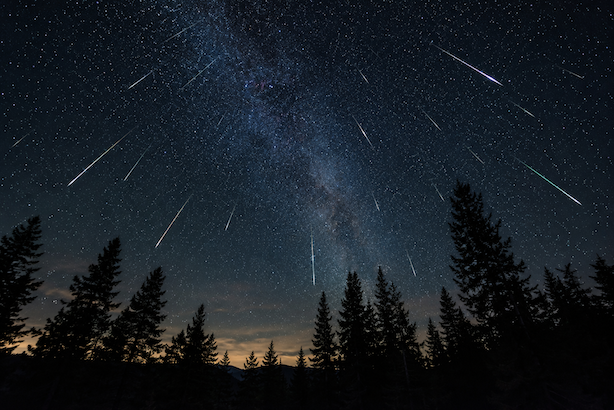
AI-ceated image of a meteor shower similar to the Perseids.
Space Calendar / What to look for in the August skies
AUGUST 12-13
Perseids Peaks
Active from July 17 through Aug. 24, the Perseids reach their peak on Aug. 12-13, and the meteor event is one of the most anticipated of the year. Under dark skies, you can expect up to 100 meteors per hour. This year’s conditions are nearly ideal — the new Moon on Aug. 12 leaves the sky completely dark for optimal viewing.
For best viewing, watch from midnight to 4 a.m. on Aug. 12-13. While meteors appear as early as 8 p.m., activity peaks in the predawn hours. Radiant (where meteors appear to come from in the sky) lies in the constellation Perseus, high in the northeastern sky after midnight. Seek dark skies away from city lights and lie flat on your back with a clear view of the northeastern sky. Don’t stare directly at Perseus; meteors appear overhead. Allow 15-20 minutes for your eyes to adjust to darkness. Perseids are known for their bright, fast streaks, some with colorful trails.
AUGUST 15
Venus at Greatest Eastern Elongation
Venus reaches its greatest separation from the Sun, appearing 45.9° east of it in the evening sky. This is the best time to view the planet, as it shines brilliantly at its highest point above the western horizon after sunset.
Often called the Evening Star, Venus will be the brightest object in the sky after the Sun and Moon. It remains visible for several hours before setting, glowing with a steady white light that’s easily seen even from urban areas.
AUGUST 28
Partial Lunar Eclipse
A partial lunar eclipse occurs when the Moon passes through Earth’s shadow. For this partial eclipse, only the lower portion of the Moon enters the shadow, creating a reddish-orange shading along the bottom edge while the upper half stays bright. Best of all, this eclipse happens in the early evening so you don’t even have to stay up late to see it.
For central North Carolina, look east shortly after sunset on Aug. 28. The Moon will rise around 7:45 p.m. already in shadow. The eclipse will reach its darkest point at 8:36 p.m., then gradually brightens again by 8:59 p.m. As the Moon rises through the humid summer air, it will appear orange and dimmed, creating a warm, copper-colored glow.
Viewing Tips: No special equipment needed — just step outside and look east. For those looking to capture some amazing photos, try to include trees, barns or buildings in your view for a sense of scale.
AUGUST 28
Full Sturgeon Moon
August’s Full Moon, the Sturgeon Moon, reaches full illumination at 12:18 a.m. Named by Indigenous peoples for the great sturgeon fish plentiful in late summer, it’s also known as the Grain Moon or Lightning Moon, signaling the transition from summer to harvest.
MOON PHASES
■ Last Quarter: August 5, 11:22 p.m.
■ New Moon: August 12, 2:37 p.m.
■ First Quarter: August 19, 11:46 p.m.
■ Full Moon: August 28, 12:18 a.m.