
© 2026. Randolph Hub. All Rights Reserved.
Welcome!
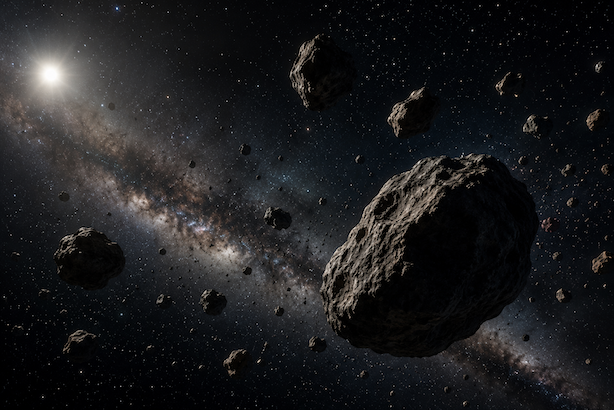
Asteroid day is at the end of the month, a United Nations-sanctioned day of public awareness around planetary defense and the risks asteroids pose to Earth.
Space Calendar / What to look for in the June skies
What’s up in June? Here’s when to look up and find out.
JUNE 9
Venus-Jupiter Conjunction
On the evening of June 9, Venus and Jupiter — the two brightest planets visible from Earth — will appear just 1.6 degrees apart in the western sky after sunset, about the width of a thumb held at arm’s length. Look low in the west-northwest about 30 to 45 minutes after sunset. Venus will blaze at magnitude -4.0, unmistakably bright; Jupiter will glow just beside it at magnitude -1.9. Together they will resemble a brilliant double star sinking toward the horizon.
A clear, unobstructed western horizon is essential. Find higher ground or a west-facing field well before the sky darkens. The planets will set roughly an hour after the Sun, so timing matters. No equipment is needed, though binoculars will show both planets as distinct discs in the same field of view.
JUNE 21
Summer Solstice
The summer solstice arrives on June 21 at 9:24 a.m. EDT, marking the longest day of the year in the Northern Hemisphere and the official start of astronomical summer. The Sun reaches its highest point in the sky relative to the celestial equator, and from central North Carolina in Asheboro, daylight stretches to roughly 14.5 hours.
From this day forward, daylight shortens gradually until the winter solstice in December.
JUNE 29
Full Strawberry Moon
The Full Strawberry Moon rises at 7:57 p.m. EDT. The name comes from the Algonquin peoples of northeastern North America, who recognized June’s full moon as the signal that wild strawberries were ripening and ready to gather. Other traditions mark the same seasonal moment differently — the Ojibwe called it the Blooming Moon, the Cherokee the Green Corn Moon, and European custom gave it the Rose Moon or Honey Moon, the likely root of the word “honeymoon.” Because the Sun rides high in summer, the full moon opposite it traces a low arc across the southern sky — a hallmark of summer full moons at mid-latitudes.
JUNE 30
Asteroid Day
June 30 marks Asteroid Day, a United Nations-sanctioned day of public awareness around planetary defense and the risks asteroids pose to Earth. The date is the anniversary of the 1908 Tunguska Event, when a small asteroid or comet fragment exploded over a remote Siberian forest with the force of roughly 1,000 atomic bombs, flattening some 800 square miles of trees. No one was killed, but it remains the largest known impact event in recorded history — a reminder that the solar system still sends debris our way.
More recently, in February 2013, a previously undetected asteroid roughly 60 feet across entered the atmosphere over Chelyabinsk, Russia, and exploded without warning at an altitude of about 14 miles. The airburst released energy equivalent to nearly 30 Hiroshima bombs, shattered windows across six cities, and injured more than 1,500 people — most of them cut by flying glass. It was the largest recorded impact since Tunguska, and no one saw it coming.
MOON PHASES
■ Last Quarter: June 7
■ New Moon: June 14 – 10:54 p.m.
■ First Quarter: June 22
■ Full Moon: June 29 – 7:57 p.m.