
© 2026. Randolph Hub. All Rights Reserved.
Welcome!
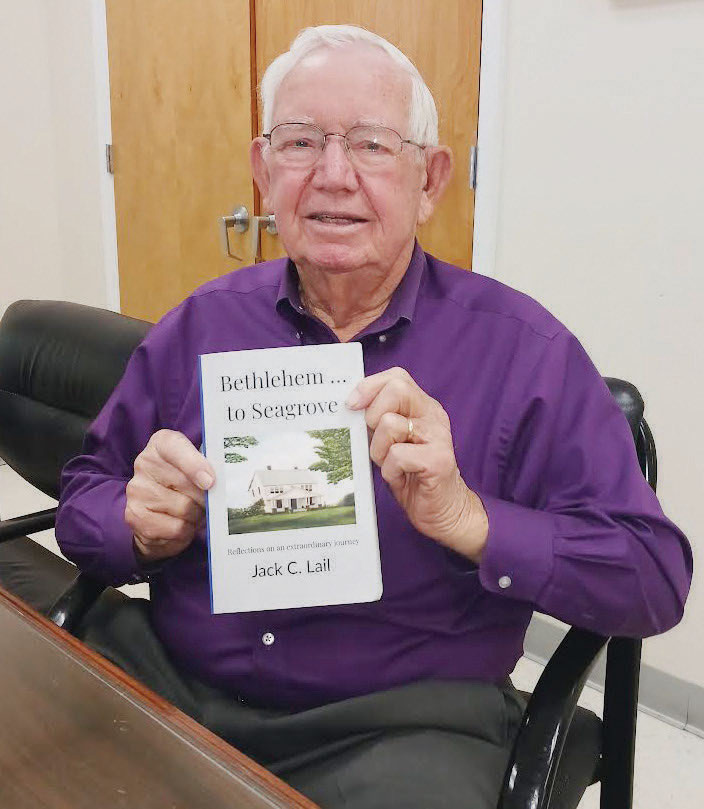
Jack Lail holds a copy of his memoir, ‘Bethlehem ... to Seagrove: Reflections on an extraordinary journey.’ (Photo: Larry Penkava / Randolph Hub0
A tale worth saving
SEAGROVE — Born in the depths of the Great Depression, the 10th of 12 children on a family farm facing foreclosure, Jack Lail rose from humble beginnings to eventually establish a multi-million-dollar industry.
His recently-published autobiography, “Bethlehem … to Seagrove: Reflections on an extraordinary journey,” is a page-turning memoir of how Lail went from milking cows and picking cotton to running a state-of-the-art plastics factory.
Lail writes, “I was born on April 6th in 1933 in a small, partially log house on the small family farm west of Bethlehem School. Bethlehem, North Carolina, was at the time, a very rural community in the southwest corner of Alexander County in Wittenburg Township. It was on the banks of Lake Hickory, recently created in 1928 by Duke Power.”
He goes on to describe those times: “There was a lack of money for even basic necessities for many families in America and especially rural areas. We saw the start of the Great Depression with 15 million people unemployed.”
“Bethlehem … to Seagrove” describes Lail’s journey from the farm to success in business, from agrarian life to world traveler. And the book does so in his down-to-earth style.
So why now, at the age of 93? Lail credits Sue Spencer, who he called the historian of southern Randolph County.
“She’d been on me a couple of years to do the history of Mid-State,” he said.
Added to that, Sandra Lail, Sapona Plastics vice president of sales, provided him with a device to record his voice and then print out the text. She also helped with research.
Lail’s oldest son Jack D., who is a retired journalist, helped with best practices and publishing.
Lail began dictating his story in February 2025 and took a bit more than a year, off and on, to complete the book.
“My memory for dates is really good,” he said. “We also had records and newspaper clippings. I had good recollections of things that happened.”
Bethlehem is in the southwestern corner of Alexander County where it comes together with Catawba, Caldwell and Burke counties. His family’s first farm was a rental property on Lake Hickory but they bought another farm when he was about 6 or 7 years old.
Much of the book details how Lail was led to starting his own business. He joined the US Navy in order to qualify for the GI Bill, which allows veterans to go to college.
While in the Navy, he married Betty Edwards of Hickory.
“When Betty and I were dating, we talked about farming,” Lail said. While he enjoyed living on the farm, Betty had other ideas. Eventually, the economics of farming weren’t ideal.
Lail had received training in electrical work in the Navy and he proved adept at “figuring out problems.” He also proved good at judging people.
“It took about half a day for me to tell if a person was a good worker,” he said. “Attitude was the biggest factor.”
After the Navy, Lail spent time with a defense contractor before realizing that the industry had its ups and downs. That’s when he chose to accept an offer by General Electric in Asheboro.
It was while at GE that Lail entered Guilford College, working full-time and going to school during his off-hours. Working at GE provided him with experience in maintenance electronic technician, quality control, product service and purchasing.
Purchasing, Lail said, was the “turning point.” He would see men who worked for themselves driving fancy cars and wearing suits.
As he moved up the ladder at GE, he realized the next step would require moving out of state. “I started worrying about where I was going.”
Then a good friend at Hamilton Beach in little Washington, NC, “wanted me to take over their molding operation. I took the job in 1970 and stayed ’til ’72.”
Meanwhile, Lail went in with a partner to form Mid-State Plastics in Seagrove. Lail had stayed on at Hamilton Beach as a show of loyalty before joining Mid-State full-time. One of their biggest customers was Hamilton Beach.
In his book, Lail tells how they upgraded their equipment to manufacture medical products and other specialty items. After 25 years, they sold the company and Lail stayed on as a vice president for three years.
It was hard for him to see the business he had worked so hard on be run into the ground. From sales of $32 million the year they sold the company, the new owners filed for bankruptcy after five years.
A few years later, when another plastics company was liquidating, the Lail family started Sapona Plastics with Dean Lail the president and majority owner. That business is going strong.
“I wrote (the book) for two groups,” Lail said, listing, first, those wanting the history of Mid-State Plastics, and, secondly, for his extended family so they would know the circumstances of the elder Lails.
He tells his grandchildren and other youth, “You better read this before deciding what you’re going to do with your life.”
Before finishing the interview, Lail had one more statement: “I think women can run a business as well as a man can. Lib Cox and Sandra are examples. Just give them a chance and they will prove they can do it.”
Copies of “Bethlehem … to Seagrove” can be found at Amazon or on the website, www.bethlehemtoseagrove.com.