
© 2026. Randolph Hub. All Rights Reserved.
Welcome!
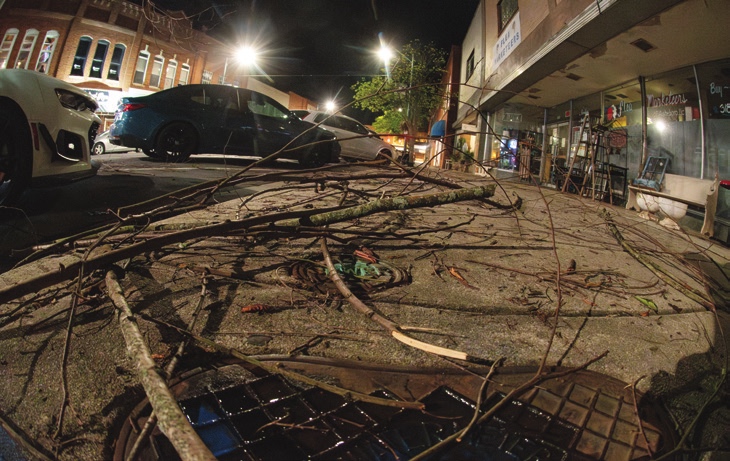
Debris in the streets of Asheboro after the straight-line storm winds roared through town on Sept. 5. Cleanup continues.
After microburst, city responds, recovers
ASHEBORO — One week after a powerful microburst tore through Asheboro, downing hundreds of trees and knocking out power to thousands of homes, the city has shifted from emergency response to recovery — an effort officials say could take weeks.
What happened
Just after 3 p.m. Saturday, Sept. 5, meteorologists and storm spotters were tracking a line of strong thunderstorms moving southeast across central North Carolina toward Asheboro. Around 3:14 p.m., one of those storms passed directly over the city of Asheboro.
Thunderstorms are fueled by updrafts, columns of warm, rising air that hold
a storm’s core of rain and hail aloft as it builds. Without wind shear to tilt the storm, the core can grow too heavy for the updraft to support or a disruption in the updraft can cause the core of the storm to collapse. When that happens, tens of thousands of feet of rain-cooled air slams into the ground and spreads outward as straight-line wind, carrying heavy rain with it.
The National Weather Service said what happened to the storm as it passed over Asheboro was a classic example of a “core drop and resulting microburst.”
A microburst is a small, concentrated version of that collapse: Wind speeds can reach 100 mph, comparable to an EF-1 tornado. That burst of wind is likely what brought down hundreds of trees and power lines across Asheboro in a matter of minutes.
The scale of the damage showed up almost immediately in 911 call volume. Randolph County 911 fielded more than 103 storm-related calls by 5:30 p.m. Saturday. The county said dispatchers answered 276 total calls between 3 and 4 p.m. alone — about four calls a minute for an hour straight.
Of the 153 storm-related calls logged through Sunday afternoon, 131 — about 86% — involved trees down: 69 blocking roads, 49 tangled in power lines and 13 that fell on homes. The 911 center also received 22 calls reported downed power lines, according to county 911 call logs.
Randolph County Emergency Services reported no injuries related to the storm.
Response and recovery
The City of Asheboro declared a state of emergency the next morning, less than 24 hours after the storm passed. Mayor Joey Trogdon signed the declaration effective 8:45 a.m. Sunday, Sept. 6. The state of emergency gave city building inspectors and fire marshals more flexibility to work alongside electricians to reenergize homes, and allowed the city to bring in outside resources as needed.
More than 40 streets across Asheboro were impacted, and more than 3,000 residents were without power Saturday night. Duke Energy and Randolph Electric crews worked through the weekend alongside city crews to clear streets and restore service. By Sunday, more than half of residential customers had power back; by Monday evening, service had been restored to nearly everyone.
The city’s water and wastewater systems stayed operational throughout, though about 20% of wastewater pump stations — including the city’s water treatment system and the Lake Lucas facility — ran on backup generators through Sunday.
By Sunday morning, city crews had finished removing the last of the downed trees blocking roads, allowing them to shift from response to recovery.
“We are now in recovery mode. The priority is safety of residents who had storm damage,” City Manager Donald Duncan Jr. said.
In an email on Sept. 8, Duncan said building inspectors, the fire marshal and the fire department were assessing damage citywide, and that public works and public services crews — whom he thanked for working in hazardous conditions to reopen streets in the storm’s immediate aftermath — had shifted into debris removal, starting in the hardest-hit areas.
He said he recommended keeping the state of emergency in place through the end of the month to give residents time to move debris to the roadside for pickup.
As of the end of the day Wednesday, crews had hauled away 77 dump truck loads of debris or roughly 160.75 tons. The effort had taken 534.5 staff hours and 290.5 equipment hours, which Duncan said is the equivalent of 6.7 people working full time for two weeks, or one employee working full time for just over three months.