
© 2026. Randolph Hub. All Rights Reserved.
Welcome!
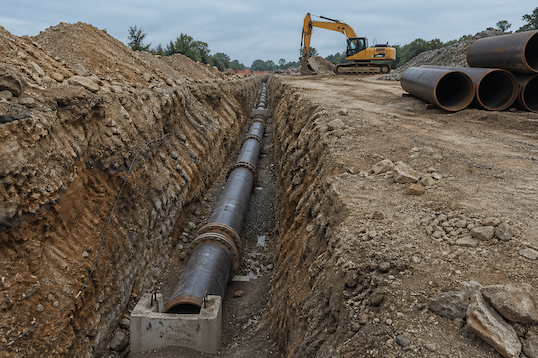
Photo illustration of a water line under construction.
County, city work together to tackle water issues in eastern Randolph
ASHEBORO — The Asheboro City Council and Randolph County Board of Commissioners have approved an interlocal agreement for water and sewer development.
At the commissioners’ meeting on April 2, County Manager Zeb Holden said the agreement will help build up water infrastructure in eastern Randolph County and help the Seagrove Ulah Metropolitan Water District (Seagrove-Ulah) make much-needed upgrades.
Commissioners approved the agreement contingent on the city council’s approval, which the council voted to approve at its April 5 meeting.
The interlocal agreement includes the following:
■ Randolph County will guarantee up to $16,447,202.20 for Phase 1 of the Wolfspeed line. If the line costs less, Asheboro can keep up to $3 million of the remainder for capital improvement for Seagrove-Ulah.
■ A water purchasing agreement for the Wolfspeed water main’s first 1.25 million gallons of water per day. Asheboro will purchase from Randolph County’s Piedmont Triad Regional Water Authority (PTRWA) water allocation at an initial 2027 fiscal year rate of $3.30 per thousand gallons.
■ Asheboro will assume ownership, management and control of the Seagrove-Ulah water district within 18 months. It will create a separate enterprise fund to limit liability to Asheboro customers until it’s financially feasible to merge.
■ Beginning July 1, Asheboro will serve as operator in charge of Seagrove-Ulah and assist the water district in procuring services for a study of its utility system.
■ Randolph County will transfer 100 acres of 10/70 development rights of the Back Creek Balance Watershed and 20 acres of 10/70 development rights of the tributary to Cedar Fork Creek Balance Watershed, pending approval by the state.
Commissioner David Allen called it a big win for the county. He said it brings more potential for Seagrove to grow. Its water district is struggling to keep up with customer needs, which Allen said deters interest from developers and industries.
“There’s a lot of potential along the Highway 64 corridor and Liberty and north up [NC-22],” he said. “And I’ve Water been on the board nearly 12 years now, and Seagrove-Ulah has just been the thing that just will not go away. This solves that problem for the county.”
Commissioners have already begun engineering and design to upgrade Seagrove-Ulah’s wastewater package treatment plant. It’s expected to cost $4,500,000 and be operational in December 2027.
“The only entity that can fix the Seagrove problem is the City of Asheboro,” Commissioner Chair Darrell Frye said, “and we want to give them the resources to do that.”
Frye brought up Pinewood Country Club and the future Loves truck stop as examples of increasing water needs.
The county has received $85 million from North Carolina for infrastructure, which includes making water line connections. The city and county have also agreed to scale up one water line to Asheboro from 16 inches to 24 inches, so it can move more water into Eastern Randolph County.
Asheboro is also relying on the county to help with water-related construction. Earlier this year, they reached a verbal agreement for Randolph County to help pay for the Wolfspeed water main. At the Feb. 5 council meeting, Water Resources Director Michael Rhoney said they had to pause work on Wolfspeed because the state had allocated $55 million for 12 miles, and the project had grown to 16 miles. As of February, the cost had already reached $51,746,386.
Asheboro City Manager Donald Duncan said working with PTRWA will be a tremendous boon for the city’s growth. He said they anticipate about 3,000 new homes in the next few years, and the NC Zoo and the Zoo City Sportsplex are generating more visitors.
“Finishing part of the Eastern Randolph County line would also allow to eliminate some dead ends in the city’s network,” Duncan said. “You have to think of water just like electricity; it has to always flow. If it’s a dead end, then there becomes a short circuit. This eliminates a lot of those short circuits and wasting of water. Because when that water sits in a pipe at a dead end, it goes stagnant, and we have to flush it.”
Additionally, if a natural disaster or other issue took out the Randleman Reservoir, he said working with PTRWA ensures the city can tap into backup sources.
Frye said the reservoir has 1.5 million gallons of treated water and 7.5 million gallons of raw water which can be treated or sold.
Frye and Holden thanked all leadership and staff for their collaboration.
“Most counties and municipalities — and their schools — don’t get along like we do,” Frye said. “It’s only because we sit down face to face, and we respect one another and talk about what we like and what we don’t like.”
Holden said, “We appreciate your efforts to make sure we get to the finish line.”