
© 2026. Randolph Hub. All Rights Reserved.
Welcome!
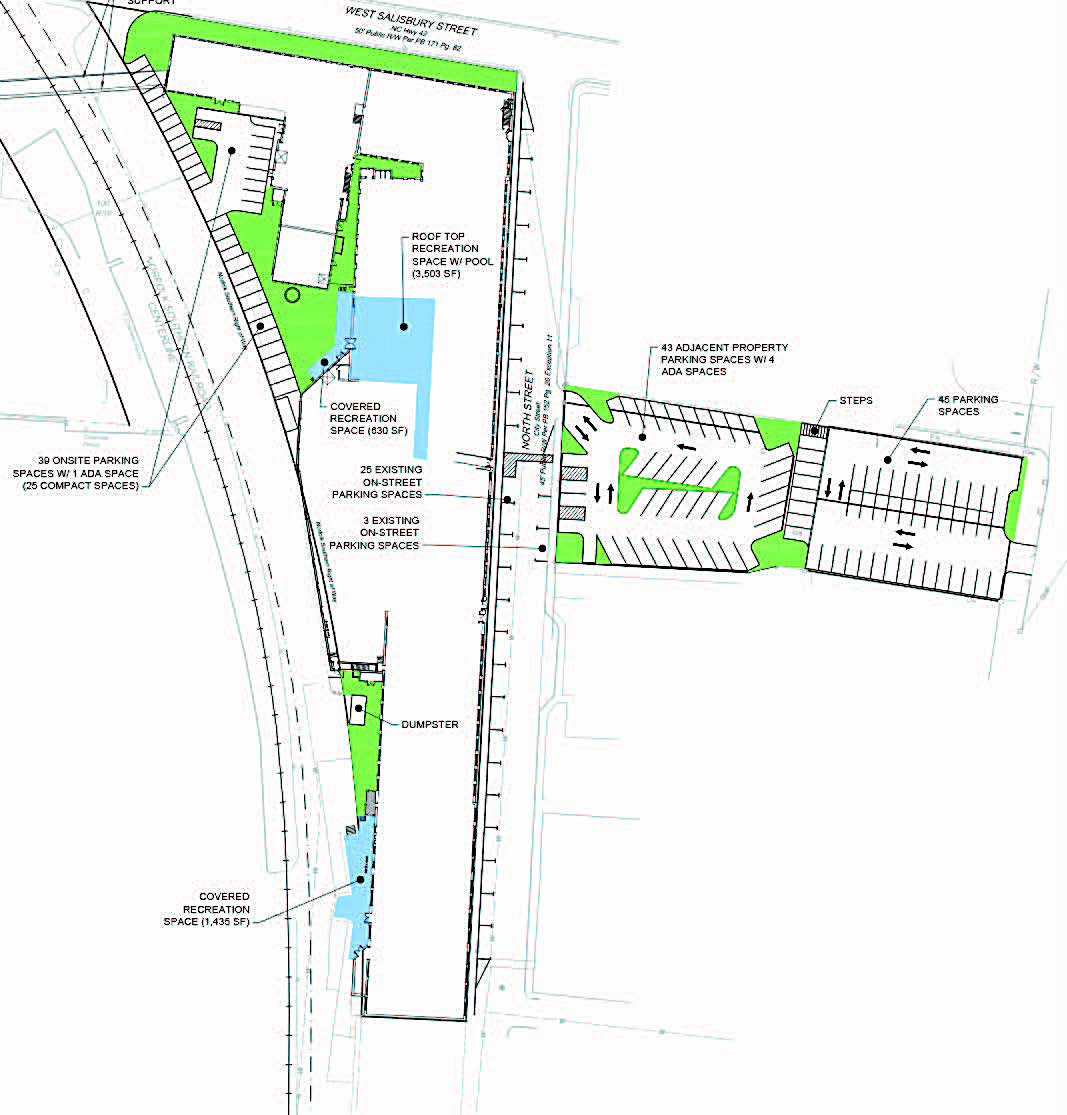
Map shows where the developer of the old mill plans to put parking spaces for the expected residents.
Developers of Acme-McCrary Mill come up with 155 parking spaces for the project
ASHEBORO — The parking around downtown came up repeatedly while the Asheboro City Council talked to the developer who plans to turn Acme-McCrary Mill into an apartment complex.
At their Nov. 6 meeting, the council met Herb Coleman, co-founder of Clachan Properties. His company specializes in renovating historic buildings. Their work spans North Carolina, South Carolina and Virginia.
“I find buildings by following rivers and railroad tracks,” he told them. He said he first reached out to Asheboro Planning and Zoning Director Justin Luck when he learned Acme-McCrary would be closing the mill on North Street and West Salisbury Street.
The council rezoned the mill and two properties on the other side of North Street from a mix of office and commercial to OA6 (CZ) Office-Apartment Conditional Zoning.
Residents and downtown visitors will not see construction soon. “It’ll be a number of years before we start driving nails,” Coleman said.
Finding parking space
Luck said regulations for this type of project require one parking place per unit. He presented a proposal with a maximum 151 units.
They made several modifications to reach 155 parking spaces:
■ Demolish the former law office building of Charles T. Browne for parking.
■ Create 25 “compact” spaces, slightly smaller than minimum size requirements.
■ Add 39 on-site parking spaces within the railway right-of-way access.
Furthermore, Luck said the current public parking along North Street can count toward the 155, even though they can keep those available for public use.
Council member Bill McCaskill pointed out the difficulty of finding a parking place as it is now for dining out, shopping or visiting the recreation center. “There’s going to be competition to get these between regular people wanting a parking spot and people living in the apartments,” he said.
Luck said the future of Acme-McCrary was factored into last year’s downtown parking study, and it did not anticipate removing any of the current public spaces for new residents.
Coleman said parking issues are common in the revitalization of urban properties. He said Clachan worked on the Winston Factory Lofts in Winston-Salem, and Acme-McCrary would have a similar parking space per bed ratio.
Council member Clark Bell asked if they would reduce the number of units should this parking plan not pan out. Coleman said it is possible, but they want to maximize the space.
Working with the railroad
One of the biggest unknowns, Coleman said, is the railroad. They expect to spend some time seeking a long-term agreement from Norfolk Southern. He said, “Because this will be a [Housing and Urban Development]-financed process … you have to have a building that’s unencumbered. This sits in the railroad right-of-way, unfortunately.”
He said they hired a consultant to handle that interaction. If they don’t get the agreement, they have other contingency plans.
The mill’s unique footprint will also influence the look of the apartments. The proposed layout is for 77 one-bedroom, 70 two-bedroom and four three-bedroom units. Each will be leased at market rate.
Clachan also proposes a rooftop pool, fitness facilities and a clubhouse. They also will leave an option for converting up to 7,500 square feet into shops or restaurants.
Mayor-elect Joseph Trogdon, Jr. asked about their experience building for retail. Coleman said, “We’ve probably 15 or 20 commercial tenants in various buildings, but we’re mainly multi-family guys.”
Attorney Bob Wilhoit is representing the development. He pointed out that other mills in Randolph County are in disrepair. He said, “It will save this building. Their efforts will enhance this building and bring an opportunity for citizens.”
After approving the rezoning, council members agreed they want to see this project move forward. Eddie Burks said he has been thinking about the future of the property for many years. “I like to look at 20 years for our city,” he said. “I had to do a little bio and was talking about reutilizing these vacant spaces. [Acme-McCrary] wasn’t vacant at the time, but you knew it was coming. You look around the city, you see new uses for these old buildings.”
Charles Swiers told Coleman, “Thank you for following the river and the railroad.”