
© 2026. Randolph Hub. All Rights Reserved.
Welcome!
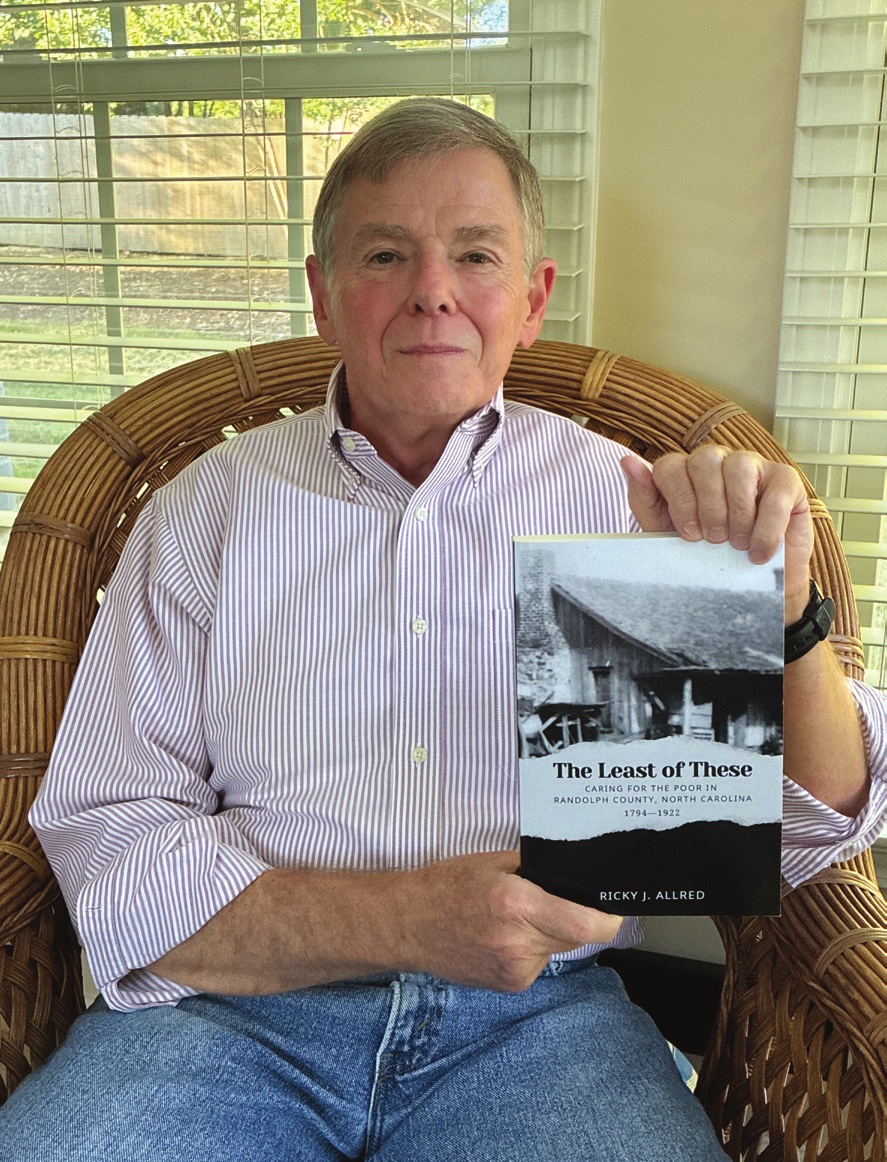
Ricky Allred turned his search into the history of the County Poor House into a look at the people who lived there. (Photo: Janet Imrick / Randolph Hub)
Local historian Ricky Allred’s book tells the stories of the county poor
ASHEBORO — The final resting place for more than 400 people is far off the beaten path in Randolph County. Once Ricky Allred located it along Caraway Mountain Road in Sophia, he went on a mission to identify the people buried there. Most of them are connected only by the place they called home: the County Poor House.
On Oct. 30, they will finally get some memorialization.
Allred will oversee the installation of a permanent monument recognizing their place in Randolph County history.
“Each of those people had some kind of a story,” he said.
“I wanted to record them just so that they would be remembered somewhere.”
Allred, who is paying for the monument, also published a book about his research: “The Least of These: Caring for the Poor in Randolph County, North Carolina 1794-1922.”
Finding the Poor House Cemetery
Allred made a name for himself as a local historian, particularly for his “Walk Thru the Past” tours at Old Asheboro Cemetery which continue typically monthly in the warmer months.
About three years ago, he heard about a cemetery for the Poor House, a government-funded home for people who could not care for themselves, primarily due to poverty, lack of family or a mental disability.
“I thought it’s probably on County Farm Road somewhere; I assumed that’s where that name came from,” he said.
“At some point, I thought, ‘I want to try to see what I can find.’ “
He started his search at the Register of Deeds, reviewing land sales around that area. He came across a sale of county land that singled out one acre with a cemetery.
Once he’d found the cemetery, Allred realized his research had just begun. He was going to dig deeper into the history of the Poor House. Writing a book, he said, might be his most ambitious project yet. “I thought, if I’m going to do this, I need to record it so that somebody else can use it down the road,” he said.
The book title, from the Gospel of Matthew, came easily to Allred. He said, “Each of those people were made in the image of God.”
Tracking the history of caring for the poor
The Poor House opened in 1827. Only one of its 405 graves is marked. Allred went through census data to identify those who lived there. He found documents in the Asheboro Library’s Record Room and the state archives in Raleigh. He checked inventory lists to learn about dining utensils and the cramped bedrooms.
Back in those days, terms like “idiot” and “insane” were treated like clinical terms. They came up many times alongside the name of a resident. Sometimes, Allred found a unique descriptor. A 6-year-old boy named John Trogdon, who arrived with his mother, had scrofulous, a form of tuberculosis. A man named Alex Lackey was a shoemaker. He even found records of purchased leather and thread around that time, so it’s possible Lackey continued to make shoes at the Poor House.
Those who went to the Poor House lived under the care of a steward. The first, Charles Steed, managed the property for about 10 years. Stewards, said Allred, were selected through a competitive bidding process. Some were wealthy; others were prone to neglect and criminal activity. Some were Confederate veterans. Quite a few were Quakers.
“I had pretty good records of the bids,” he said. “The first, Mr. Steed, he started out in the 40s. ‘For $40 a year, I will take care of one pauper.’”
In 1922, Randolph County moved the residents to a new County Rest Home on South Fayetteville Street in Asheboro. Allred found the family of Cap and Mabel Burrow, who operated the facility for a time. Their children gave him valuable details about growing up there and the lives of the residents.
He dedicated one chapter to a single resident, Mary Ashworth. He walks through the process of identifying her, her family circumstances and how she came to live at the Poor House.
A new marker for the cemetery
When the Poor House closed, the cemetery remained as a “potter’s field” for those too poor for a traditional burial or with no family to claim them. One burial Allred found went back to a visiting carnival in the 1930s.
“There was a carnival worker,” he said. “The young man got sick in town and went to the hospital. The carnival moved on, and he died. Nobody at the hospital knew where his family was, so they buried him out there.”
Even after he’d published the book, Allred did not feel his work was complete. This Sept. 1, he asked county commissioners to approve the monument.
Allred said his fascination with cemeteries often begins with a name on a gravestone. That triggers his curiosity in what happened before their date of death. It made him appreciate the need of a sign memorializing the Poor House cemetery. He said, “Just having a physical object to look at while you’re talking about the story seems to make a difference.”
That sign by Wiley Monument will stand at the crest of the ridge within the property. Part of its description will read: “While those buried here may have represented the lowest level of the society in which they lived, they were made in the image of the Creator of the universe and deserve to be remembered.”