
© 2026. Randolph Hub. All Rights Reserved.
Welcome!
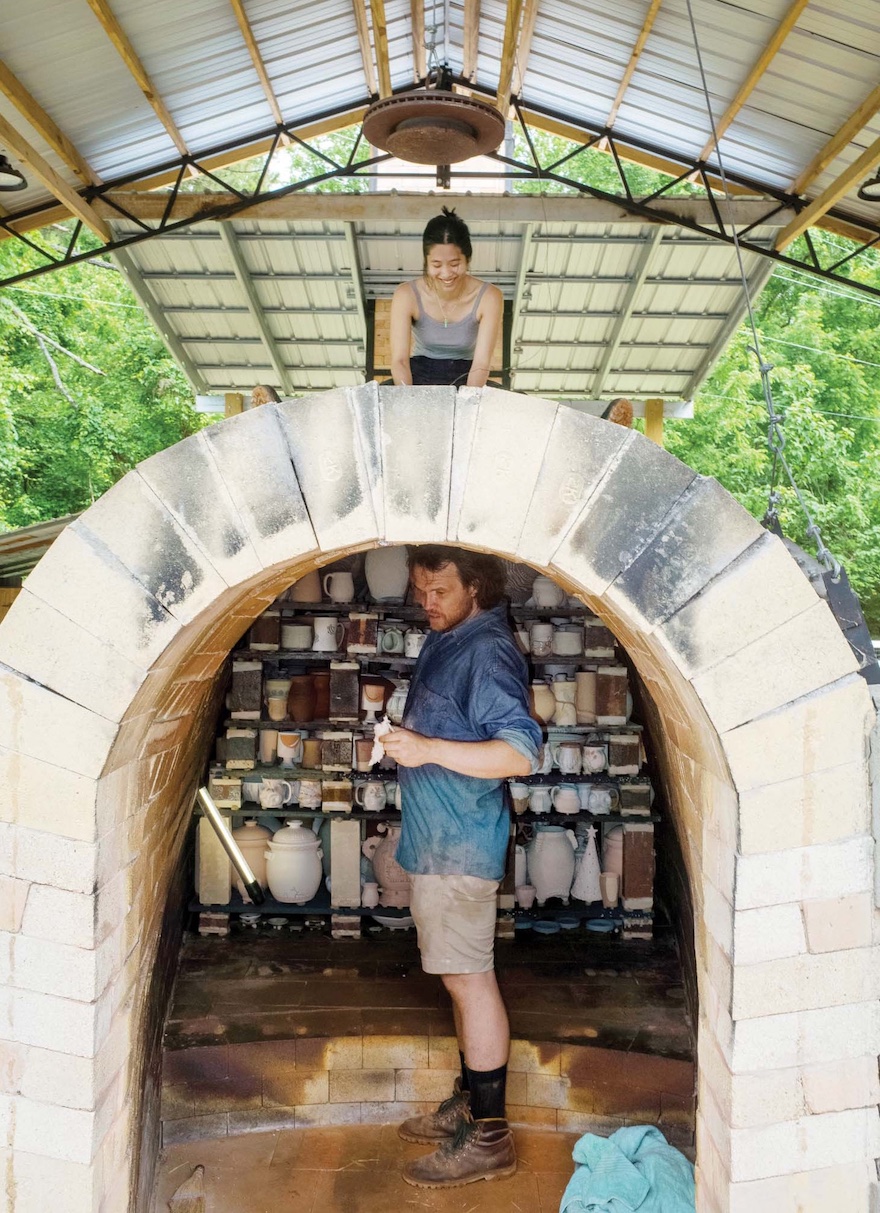
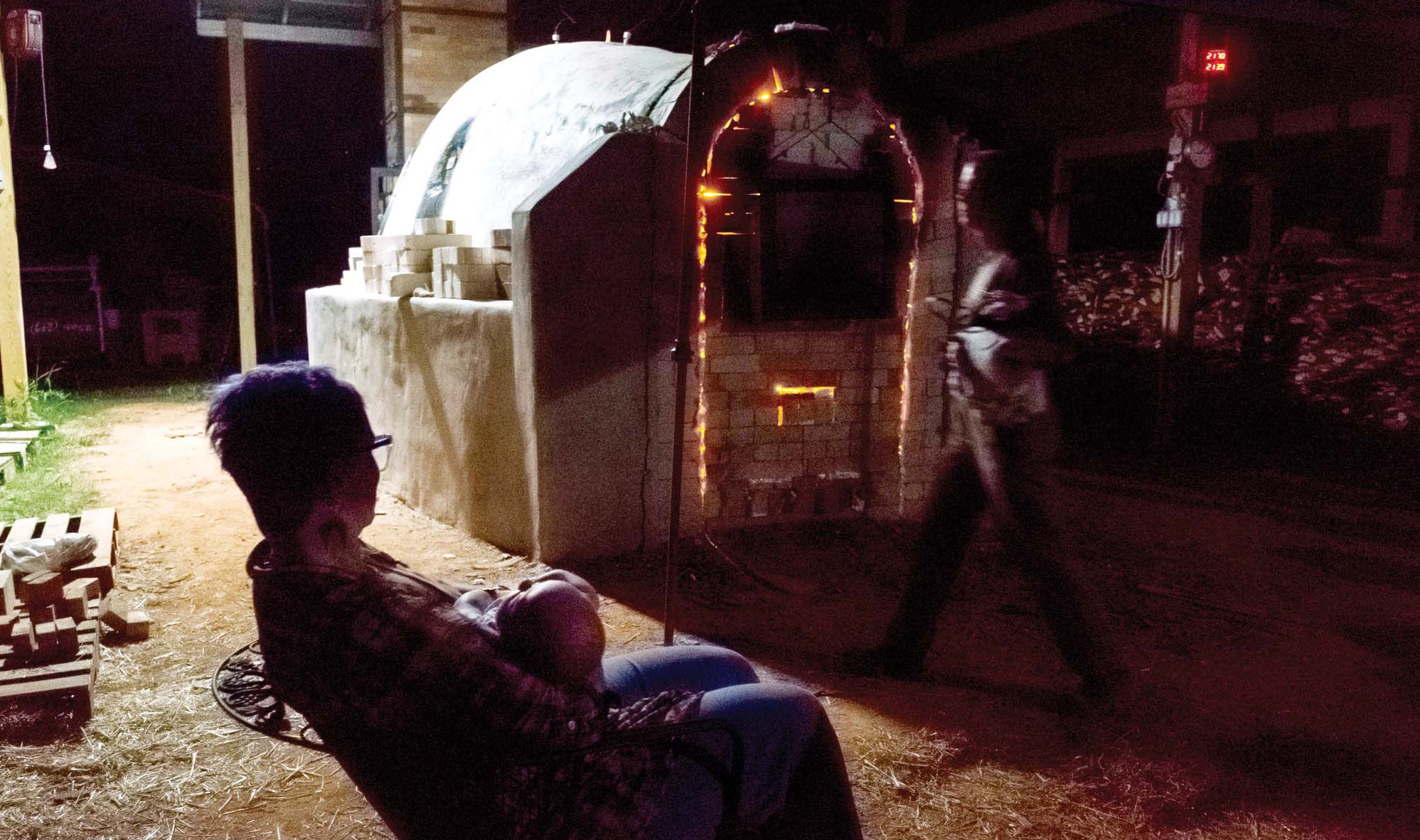
Reese Nguyen and Levi Mahan set a temperature probe through the top of the kiln during the load-ing of the kiln behind Triangle Studios. (Photos: Michael Mahan)
May the kiln gods be with us
SEAGROVE — Potter Kate Waltman knows it takes a village. Not for help with her 8-week-old son, Warren Brown, but with her 1-year-old instead — the massive, wood-fired kiln she completed in 2025.
The pottery oven sits behind Triangle Studios, in the fork where Old 220 meanders off from NC 705, a mile south of Seagrove’s sole stoplight, a hefty stone’s throw north of Whynot’s only sign.
The two roads diverge to create the wedge of land that gave rise to the triangle name for both the pottery and the building’s long-past tenant, Triangle Gas Station. Decades ago, the brick, flat-roofed building housed the service station where old men sat inside in wooden chairs, chatting and drinking colas from glass bottles, but now women — Waltman and her business partner Erin Younge — are in charge in a building brimming with creativity.
Waltman’s village, an eclectic mix of a dozen artists, assembled recently to fire her kiln, one of many in the area that were blazing for the recent annual celebration in Seagrove of the process of wood-fired ceramics. Levi Mahan, a former Seagrove potter now producing wares in Brooklyn, flew in to help Waltman organize the firing as motherhood competes for her time.
Most pottery produced by the 80 working potters in Seagrove is not fired with wood. Some ceramicists use electric kilns, like large ovens, and often use kiln sitters, which switch off the kiln automatically when it reaches the set temperature. These kilns provide repeatable, bright oxidation firings and can produce everything from functional ware to valuable works of art.
Other artists use propane outdoor gas kilns that need some manual monitoring and allow for a “reduction” oxygen-deprived atmosphere creating rustic, earthy glaze variations.
A few others dabble in raku, using tongs to place glowing hot pots into combustible material for the low-fired pots.
But only wood-firing earns its special annual dedicated weekend.
The magical mystique of wood kilns has to do not only with the pots, but with the clay, the camaraderie, the submitting one’s art to other influences: The kiln and the flame. The artist and kiln become collaborators in a method of firing that dates back to prehistoric times, evolving from wares placed into primitive open bonfires to the highly sophisticated artisanal kilns of the Seagrove area today.
Waltman’s kiln
Although the Triangle kiln was one of more than a dozen that were fired recently for last weekend’s studio tours, the different kiln designs make the kilns more distant cousins than siblings. Waltman’s kiln looks like a supine pregnant belly, a brick cave coated with layers of castable concrete.
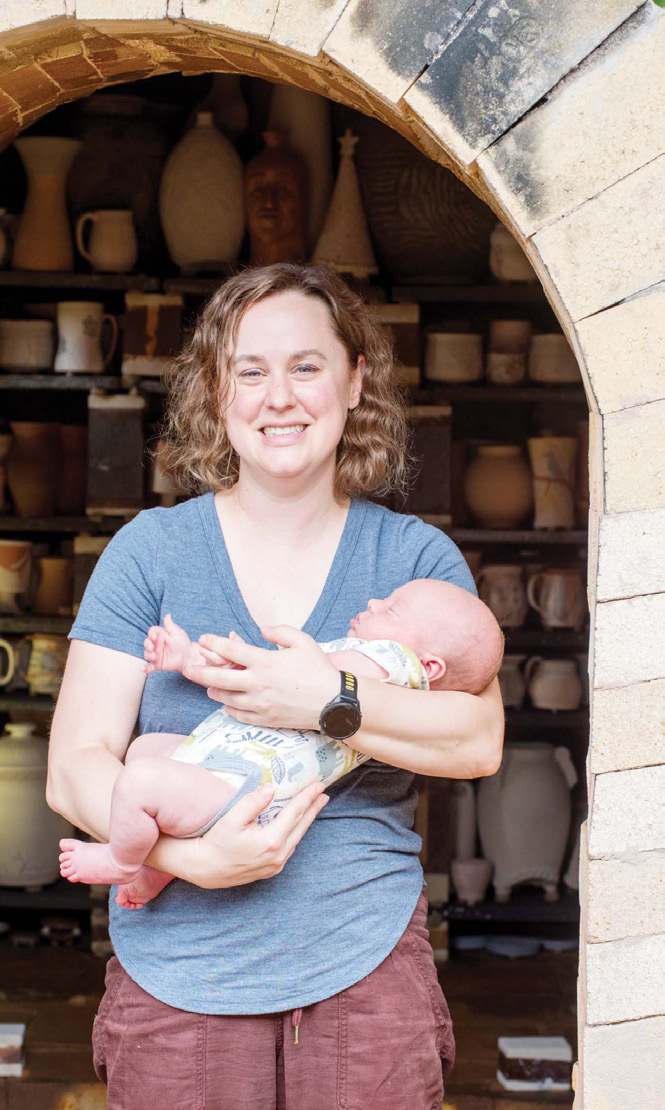
Waltman said she worked to finish the kiln before she and husband Nate Brown began a family, but her pregnancy journey began before the first firing.
The kiln itself is a work of art, a mosaic of reclaimed fire bricks Waltman amassed over several years:
■ From a Tennessee farm, nine tons of bricks she and other potters reaped from a family plot where the weeds had taken over.
■ No-longer-needed bricks gifted by Asheboro artist Mike Durham.
■ Five tons of bricks gleaned during a bitterly cold January by Waltman and other potters from a defunct tile kiln the length of a football field in Sanford.
■ A pile here, a pile there that Waltman gathered along the way.
Much of the brick had to be cleaned, which took about a year.
Waltman said her kiln is based on a classic anagama, heavily influenced by the Estonian kiln builder Andres Allik.
“The exact size and shape are based on what pots I want to make, with room for large work in the back of the stack away from the initial flame and small pots in the front of the kiln,” she said.
Waltman had plenty of kiln-building experience as she has been part of 11 kiln raisings, but the Triangle kiln was the first she constructed as foreman.
The kiln firing begins
Last week’s firing, a labor-intensive 10-day affair, was the third for the kiln. Day one began on a Sunday as Mahan spearheaded loading the kiln, a careful arrangement of the still fragile pots. Some pieces had been bisqued, an initial low-temp firing that makes ware easier to handle or glaze, but most were fragile, bone-dry greenware.
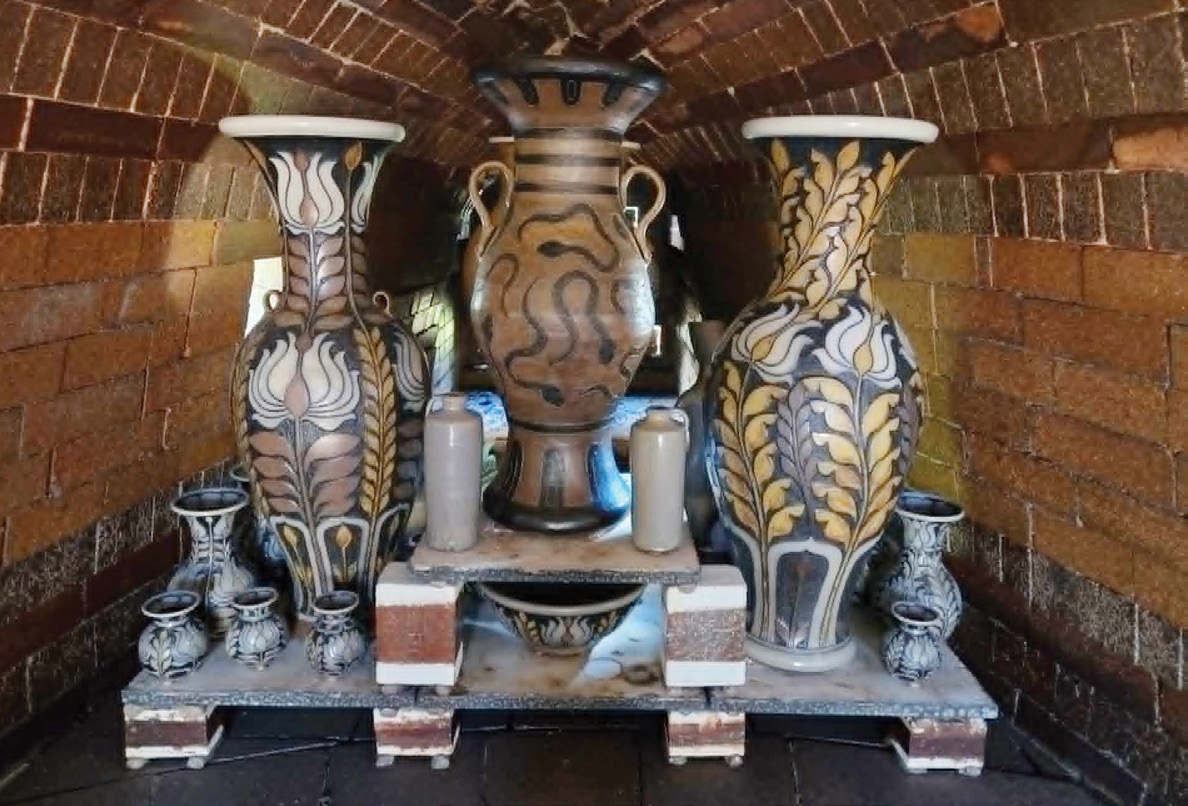
Big pots, like Waltman’s 38-inch vases or Seagrove artist Cat Viera’s yard-high pot, went in first, in the back and on the bottom. Small handbuilt figurines like artist Reese Nguyen’s tiny figurines, less than an inch, fit anywhere.
Waltman explained that kiln furniture, like brick, is expensive, and most of her shelves are used. But like people, kiln furniture sometimes bears unseen trauma from their prior lives that can spell disaster if shelves or posts fail during a firing. Envision a glowing hot pyramid of art collapsing, and it becomes clear why the potters debated the integrity of a shelf that had been through a lot. It was ultimately placed near the top, just in case, to minimize the loss in the event of a failure.
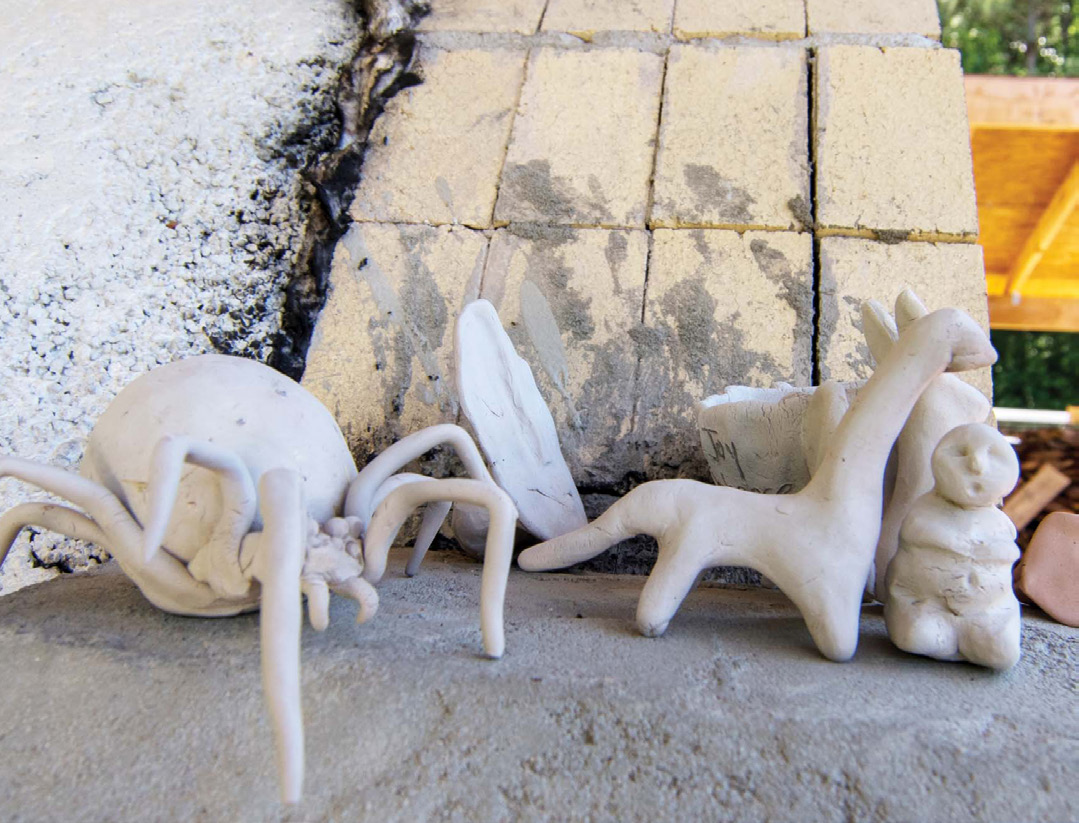
Kiln gods, small handmade clay talismans crafted by potters during previous firings, were placed alongside the pots, a worldwide ritual that dates to ancient cultures. This tradition combines whimsy, folklore and superstition, but also a portion of respect for the unpredictable nature of fire.
The opening was sealed with stacked bricks, but 12 openings in the kiln allowed for careful stoking to avoid knocking over pots or shelves.
The lighting took place with ceremony as potters tapped small twists of lighted paper to Mahan’s for him to light a small pile of kindling to create the small flames that would grow over the next 3 1/2 days.
Shifts were generally six hours, a little more or less when life demanded it.
Stoking the flames
Stokers started with oak, to burn slowly and long, to bring the pots up to temperature gradually.
Watchers determine the rising temperature by donning welder’s darkened face shields and looking through stoking/peeping holes at cone packs, small, clay lumps holding four pyrometric cones, 9-12. As the temperature rises, each cone melts and bends. Cone packs are placed in strategic spots throughout the kiln to make sure that any cold spots are brought up to temperature.
Waltman said the goal temperatures everywhere were at least cone 10, around 2,300 degrees, which would ruin the elements in an electric kiln and would collapse clay bodies not designed for such high temperatures. The front of the kiln, the hottest area, would reach cone 12, about a hundred degrees hotter.
Three days of constantly feeding and checking cone packs and the external pyrometer for progress were at times festively communal and at other times solitary and, in Mahan’s word, boring.
Colorado-based potter Chad Corbin reflected on the process. “My favorite part of the firing is the early morning shift just before the sun rises. All you hear is the crackling of the fire and the sound of the kiln breathing. It is a very peaceful time and you feel totally in tune with the process.”
Luke Robertson of Little Peak Pottery in Durham signed up for the midnight to 6 a.m shift, but came in early to enjoy the brewing storm from beneath the kiln shed. The moment she arrived, a wind blew the tarp off the wood which must be kept dry. Then the canopy shading the potters’ chairs collapsed under the weight of the downpour. “I took a pretty deep breath before I ran outside to help Chad secure both — the rain was so loud we were yelling at each other to communicate.”
Still, the kiln slowly grew hotter, hungrier, but quieter and less violent than one might imagine for a massive fire. The air was thicker with camaraderie and a sense of shared purpose than the barely visible smoke that rose from the chimney due to the raging temperatures and the efficiency of what the potters agreed was a very well-built kiln. By day two, visible flames licked from the chimney.
Daytime shifts were long, hot, increasingly physical. Feed the kiln, chat with folks in the studio, check the cone packs. Listen to music, watch the cars.
Nighttime work was different, and some potters worked in shifts of two for the company. An occasional car passed. At 2:15 a.m. on Thursday morning a waxing gibbous moon illuminated a man on a bicycle pedaling the half-mile uphill climb towards Seagrove. Dogs frequently barked from both directions.
A lesser kiln might have more cold and hot spots, more missed temperature mileposts, but the kiln gods were working their magic, and the potters began to fashion their menagerie of mini gods for the next firing. Viera made an intricate black widow spider. Robertson, some ghosts. There was a frog, a dinosaur, a snake. Mahan made his dog, Lugo, who remained in Brooklyn. Mahan’s dad, Michael, formed a swimmer to represent his senior passion, and someone else made him some waves. Waltman, naturally, fashioned a chubby baby.
Winding down
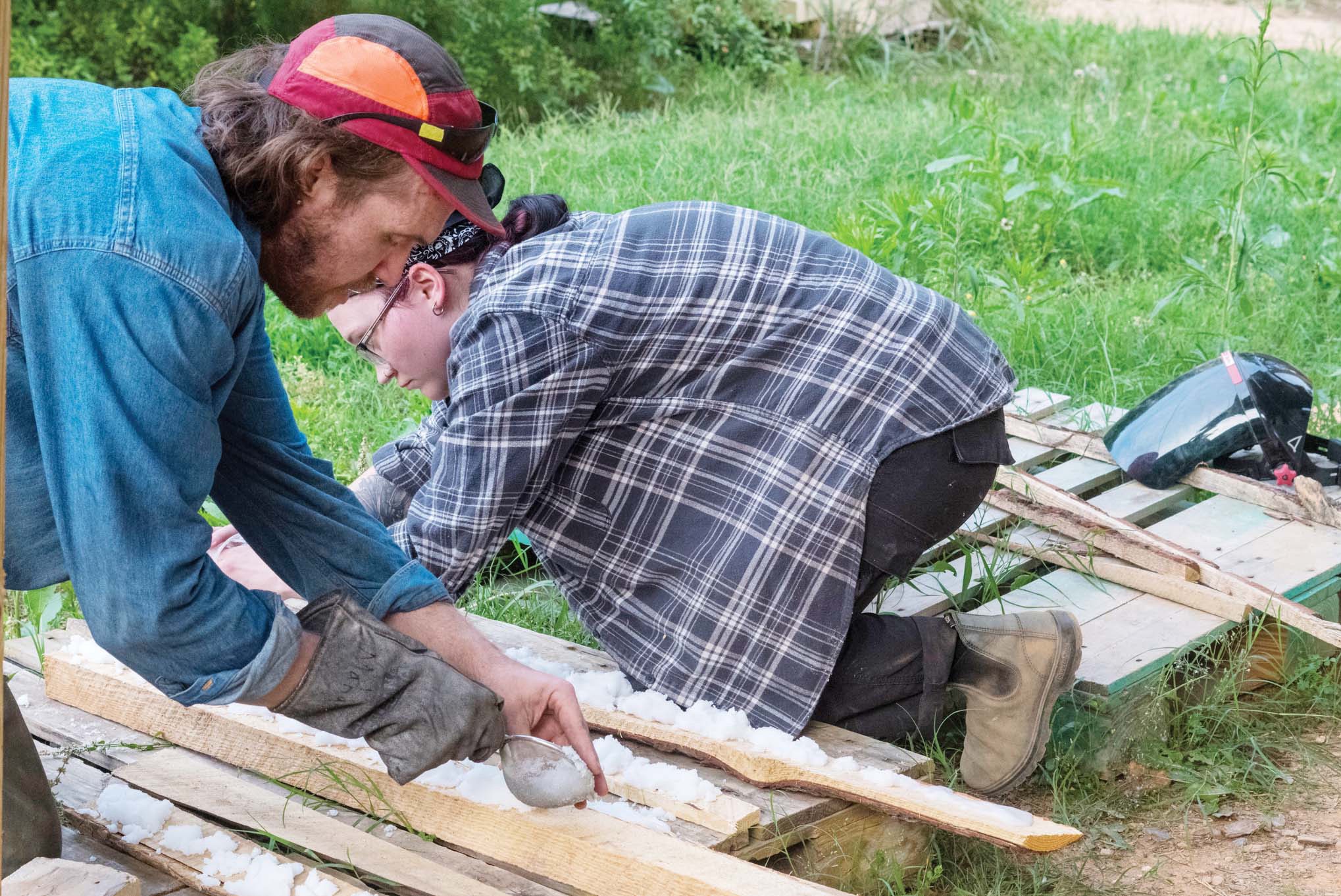
On Friday afternoon, with an estimated few hours to go, Triangle apprentice Zach Evans and Mahan began mixing a brew of hot water and salt. Not special salt, just rows of cardboard canisters like the kind in most pantries, purchased from Fresh Cuts in Seagrove.
The brine was put into a sprayer which Mahan applied through the same peep holes used to view the cone packs and stoke the flames. Not all wood kilns use salt, but the resulting organic, earthy shades of browns and grays are highly prized, and cannot be duplicated in gas or electric kilns. More salt was balanced onto the pine slabs before careful stoking.
Flames danced from the chimney. Prometheus would be proud.
Friday afternoon, the parking lot was full despite the closed sign on the gallery door. Like moths to a flame, the potters came to see the beast reach temperature. At 5 p.m., Mahan sent a group text predicting a 7 p.m. finish, but as the group gathered for a potluck taco bar, there appeared to be hours to go.
Anne Pärtna held Warren in the studio as his mother ate. He continued his sleep as Lori Clodfelter gently rocked him in the glow of the flames, which she described as her favorite part of the firing. A bit past 8 p.m., after 74 hours of stoking and monitoring, the kiln was done.
Five days passed as the kiln slowly cooled. The village stopped by now and then to peek in, but the well-built kiln was slow to surrender its heat.
On Wednesday, Waltman, Mahan and a handful of others gathered, hoping the magical alchemy of wood, fire and clay had done its work.
With any type of firing, there is some risk of losing lovingly created works of art that have demanded hours of the artists’ time; with wood firing, the probability of loss is the greatest. Every member of the village has heard stories of humbling, punishing results. The pots are their paychecks, but they are also personal.
As Mahan removed the bricks from the opening, the excitement was palpable. Anticipation bypassed caution as pots remained hot enough to melt his kiln gloves onto some of the wares. There was consternation as a few pots appeared to have been knocked over, most likely during stoking, but inspection showed they were not broken or stuck to other ware.
Tiny trinkets, massive vases, a diverse collection of mugs and vessels; the kiln gods did not disappoint.
On a scale of 1 to 10, Robertson rated the firing a 10.5. The unloading was a beauty pageant, but in this one, the camaraderie and smiles were genuine. There was a 13-way tie for Most Talented, and 500 to 600 winners in the beauty portion. Imagine 50 shades of gray, a bazillion shades of brown in a dizzying array of sizes and styles.
Gingerly, the pots were taken from the kiln where they were surprisingly clean, with little ash.
Robertson summed it up: “During the unloading process, we look at each of our pots and ask tons of questions like, what slip did you use? What clay is that? What technique did you use to make that happen? ... Most professions collaborate but talent can be closely guarded. This is never my experience with a group wood firing,”
For more photos and information ….
…. about the cast of characters involved in the project, check out the printed Randolph Hub, which you can buy from various Ready Marts and the Brightside Gallery: