
© 2026. Randolph Hub. All Rights Reserved.
Welcome!
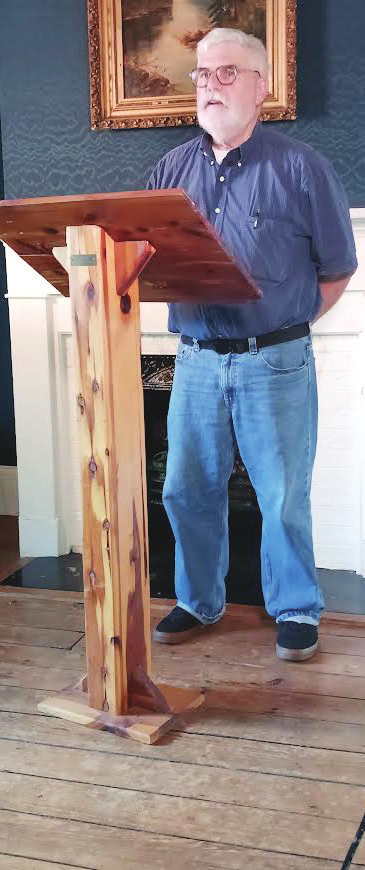
Local historian Mac Whatley talks about the formation of and migration into Randolph County while Randolph County (Photos: Larry Penkava / Randolph Hub)
Randolph County and Revolutionary War: What happened?
ASHEBORO — “Did anything important happen in Randolph County or was it on the fringe of the Revolution?”
Mac Whatley, Randolph County historian, has been asked that question. He and Ross Holt answered the question during videotaping for Revolutionary Randolph: The America 250 NC Committee of Randolph County. Whatley is chair and Holt is vice-chair of the committee.
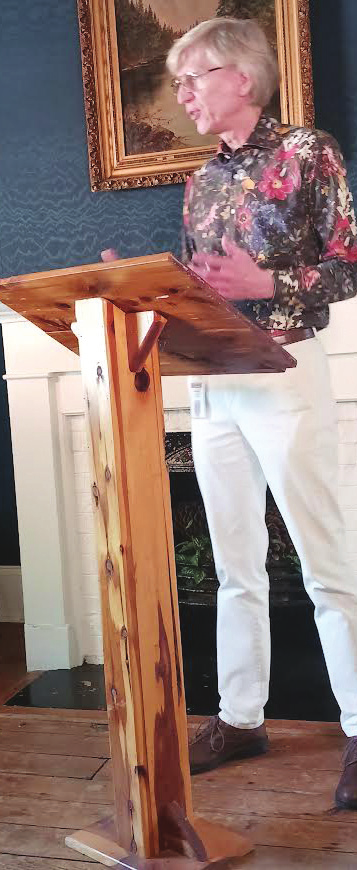
Speaking in the historic Gatekeepers House on Lanier Avenue in Asheboro, Holt asked, “What was it like to live in Randolph County in 1780 and 1781?”
For the family of Andrew Balfour, it was tragic, he said. The Balfours were inside their home when they heard a clamor. They went out to see what it was about, only to find 30 mounted men riding up the hill, led by David Fanning.
Balfour, a leading patriot, was shot and killed in front of his family.
Holt said Randolph County residents were “in a state of constant vigilance.” Many of the men who supported independence from Britain were often away from home for long periods, some tracking down loyalists to the Crown or fighting in battles in the Carolinas.
“That’s what it was like being a patriot in Randolph County,” Holt said.
He talked about William and Martha Bell, who stood against the loyalists. When William was away, Martha organized the defense of their home.
Patriots of Randolph County, Holt said, gave their lives for the cause. Many lost their homes in raids. They were changed by their experiences during the war.
“Those are the patriots that we honor today,” he said.
Whatley talked about how Randolph County, which was born in 1779 during the Revolutionary War, was in the center of the state. It was also a crossroads formed by ancient Indian paths.
Those trails brought people here from other states, the most important of whom were the Quakers and the Scotch-Irish, as well as enslaved people from Africa.
Randolph County was split off from Guilford, which in turn had come from Orange and Rowan counties.
Prior to the Revolution was the Regulation Movement, an uprising of farmers against corrupt officials and unfair taxes. While not a forerunner of the Revolution, the Regulation Movement signaled a demand for fair government.
The defeat of the Regulators at the Battle of Alamance led to the formation of Guilford County, which was further divided into Rockingham and Randolph.
Whatley said the friction between loyalists and patriots made life frightening in Randolph County.
“History does happen here,” he said, from grassroots movements to Native Americans to pioneers building log cabins. “History is all around us.”
The video of Holt and Whatley was shot by the Global Opportunities Center. It will be available on www.revolutionaryrandolph.org.