
© 2026. Randolph Hub. All Rights Reserved.
Welcome!
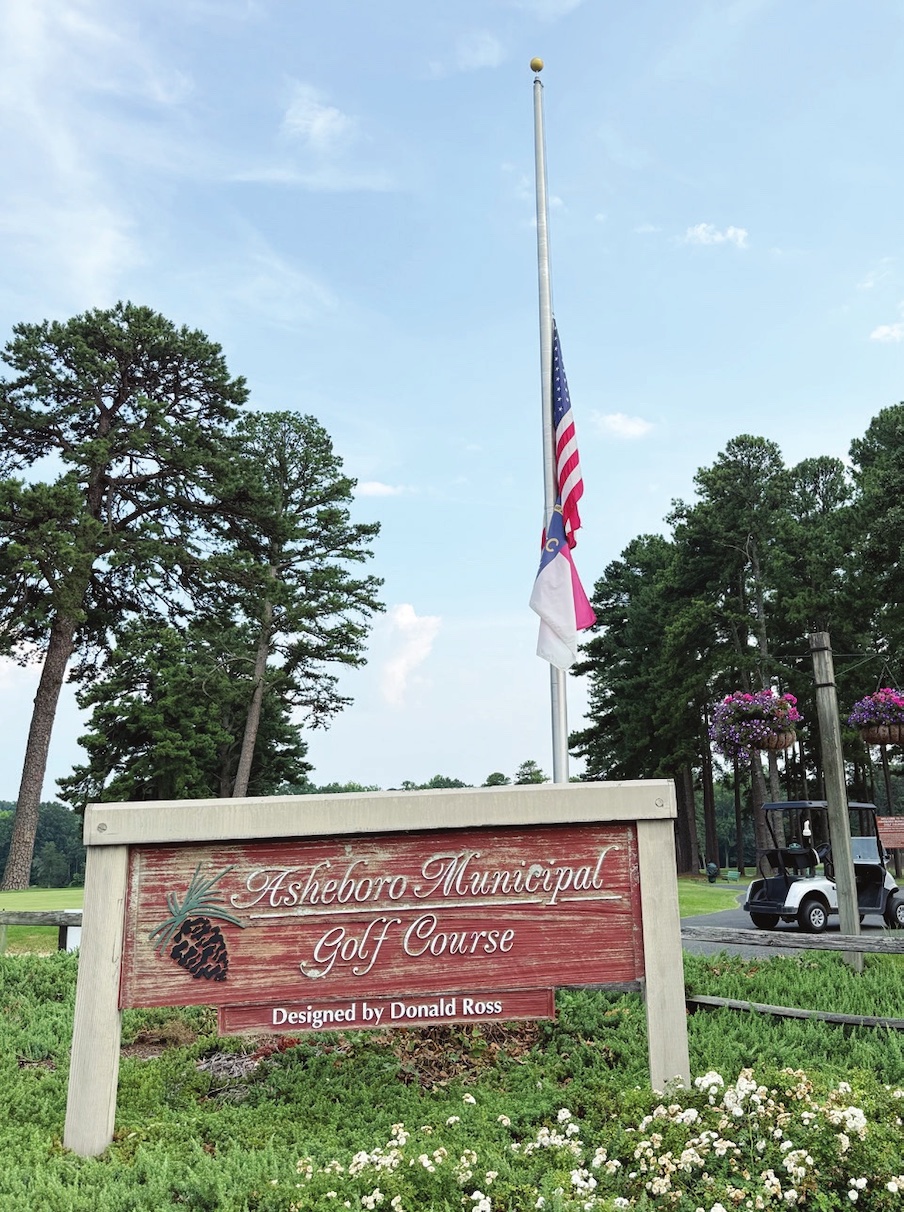
Asheboro's nine-hole city-owned golf course is a local treasure (Photo: Eric Abernethy / Randolph Hub)
Golfers concerned about rising prices at Asheboro Municipal Golf Course offer thoughts on other ways to raise funds
Graham Helsabeck
Special to Randolph Hub
ASHEBORO — My father had me on the golf course before I was 10. We played Pinewood most often, but we always knew that, if we wanted a true test, we could step onto the only course in our county designed by the most famous golf architect in history: Donald Ross.
For years, it cost just $8 to walk all day at Asheboro Municipal Golf Course. Unless visitors carried a Donald Ross map, they never realized the gem was here.
That hidden status became a central theme at the Asheboro City Council meeting on July 9, when residents urged the city to light the course for night play, install prominent highway signs, and advertise more aggressively so that the million-plus annual zoo visitors might also discover they can play a genuine Ross classic.
As Kirby Moffitt summarized, “The golf course has real potential, but it requires meaningful changes … and a strategic shift to survive.”
The Controversy
On July 1, 2026, Asheboro Municipal Golf Course implemented its first major price increase in years
and announced the end of memberships. The changes sparked strong reactions at the council meeting, particularly over their impact on senior citizens.
A longtime senior group plays on designated mornings (Monday, Wednesday, Friday and Saturday). Charlie Parks, a member of the group, explained their routine: They tee off at 9 a.m., clear the course by 9:45 a.m., and return in the afternoon — hardly monopolizing the day. Yet the group has been portrayed as a problem rather than an asset. Parks noted they spend money on-site and contribute to the course’s daily life.
Moffitt and Connor Jarrell, younger residents, defended the seniors.
“The decision to eliminate membership offerings or significantly increase rates disproportionately affects our senior citizens, who rely on this golf course for exercise and social connection,” Moffitt said. “Given our local median income, these prices are unsustainable, especially considering that five nearby 18-hole golf courses have better rates and senior discounts than our 9-hole course.”
City Manager Donald Duncan countered that the decision stemmed from complaints by non-members unable to get tee times. With only about 70 members remaining, they occupy roughly 40% of playing time while the city subsidizes each membership by approximately $3,000. “We can’t continue to subsidize play for seventy people,” he said.
Speakers like Jarrell pushed back, praising the seniors’ dedication: “I love to see it. I’m not ever mad that they’re playing golf. I hope, when I’m their age, there’s not some thirty-year-old guy mad because grandpa’s out there.” He and others called for a senior discount, a common practice at peer courses.
The city enacted these changes, beginning in January:— THEN: Walking $10 with rec card.
— NOW: $18 with rec card.
— THEN: $14 for visitor.
— NOW: $18 for visitor.
— THEN: Riding $20 for 9 holes with rec card.
— NOW: $25 for 9 holes with rec card.
— THEN: $25 for 18 holes with rec card.
— NOW: $35 for 18 holes for visitor.
Community benefits
Multiple speakers emphasized the course’s role beyond recreation. Cameron Harris, 33, credited regular play with keeping him physically active and mentally grounded. “I’ve never been in trouble a day in my life,” he said, linking that stability directly to access to the municipal course. He worried the new rates would price him out entirely.
Others echoed that the course delivers physical exercise, social connection and a sense of purpose — especially vital for seniors. Removing affordable access, they warned, could harm both individual well-being and the community fabric that the city’s own mission statement pledges to strengthen.
Cutting costs
Residents acknowledged the need for fiscal balance but urged the city to examine both sides of the ledger. Parks expressed shock at the sharp rise in expenditures shown in city graphs.
“I was flabbergasted when I saw that graph. That red line [spending] is going up sharply … Have you looked at what caused that tremendous increase?” He encouraged expense reductions alongside revenue growth.
Bill Hill noted that some 90% of the cost of operations was fixed, but urged the council to look for even small cuts that could improve the fiscal balance.
“Can you find fifty [thousand]; can you find a hundred?” Hill, who spent many years in the golf industry, warned of demand elasticity: raising rates too high could drive away the core user base and reduce overall revenue.
Increasing revenue
Ideas for enhancing revenue and building altogether new revenue streams were shared by nearly all. Bruce Moffitt (no relation to Kirby Moffitt) noted that there should be compromise. One he suggested was eliminating the preset tee time for the senior group on Saturdays to encourage a more open tee book on weekends for visiting golfers. “There’s going to have to be some sacrifice made. No more Saturdays. That’s a pretty simple compromise.”
Another suggestion came from Jarrell. “Tap into the untapped potential to make more revenue,” he lobbied. At present, there is no food. “There’s no option,” Jarrell stated, “other than a 35-cent pack of nabs.” A simple hot dog stand was shared as one option to increase revenue.
“Let’s try to do something to create revenue besides the golf aspect.”
As it stands, the pro shop is more or less unchanged for 30 years or more. Beyond hot dogs, the point was that there was little effort made at present to generate revenue from patrons.
Others shared the thought that we could have mementos and clothing and other sales options that visitors who did come to experience a historic Donald Ross gem would gleefully purchase to add to their memorabilia collection.
AMGC’s compact 9-hole layout is both a challenge and an opportunity. Players must replay the same nine holes for a full round, making direct price parity with 18-hole competitors risky — some residents said they would simply drive elsewhere.
Yet the same compact footprint makes night lighting feasible, potentially expanding usable hours.
A historic gem worth preserving
Asheboro Municipal Golf Course was designed by world-renowned golf course architect Donald Ross.
A Scot by birth, Ross was successful as a professional golfer but his passion was building courses that echoed Scottish links styles in the United States. He built many municipal courses across the USA, many of which are now Walmart parking lots or apartment complexes due to city mismanagement making them perpetual financial drains.
The municipal course Ross designed in Raleigh,
for example, was shuttered to build highways and strip malls.
Some of his designs host major events like the United States Open, played on Pinehurst #2 regularly. #2 has also hosted a PGA Championship, a Tour Championship and the US Women’s Open.
Oak Hill, a Ross design in New York, has hosted multiple PGA Championships, a US Women’s Open and even The Ryder Cup.
Oakland Hills, Aronimink, Inverness, Seminole, Scioto, Pine Needles, East Lake, Broadmoor, Siwanoy, Brae Burn, Plainfield, French Lick, and Seaview have also hosted major professional events.
Seminole is regarded as Ross’s finest design. It typically ranks in the Top 10 of all golf courses on Earth.
The PGA Tour Championship has been held at Ross’ East Lake every year for more than two decades. The tour recently announced that East Lake will remain in the rotation, but that Seminole will be added to the list of four golf courses on which the Tour Championship will rotate.
And then there’s Asheboro Municipal Golf Course. It is not a Walmart parking lot, but the fear of it succumbing to financial pressures means its fate is in jeopardy.
The course carries deep history. Opened nearly a century ago, AMGC has hosted legends and modern stars alike. Parks shared in his testimony that Webb Simpson won a junior event here; recent US Open qualifiers Akshay Bhatia and Jackson Van Paris also came through its ranks. Parks and others urged the city to pursue historic-site designation to honor and promote that legacy.
Moving forward
The July 9 meeting showed broad agreement among residents: Asheboro Municipal Golf Course is a community asset and a Donald Ross treasure that should be a source of civic pride. Residents offered constructive, low-cost solutions — better marketing to outsiders, modest concessions, expense review, and targeted compromises on scheduling — rather than simply shifting the full burden onto local taxpayers and seniors.
By shining a light on this hidden gem, the city can attract new revenue from the millions of visitors already coming to Asheboro while preserving affordable access for the residents who have supported the course for generations. With thoughtful changes, the Ross classic can thrive for another century instead of fading into memory.